
Loop Anatomy
In my senior year of high school I had the options of taking human anatomy or chemistry. My zoology teacher advised me to take the one that scared me the most, which was chemistry. So I took human anatomy. While that didn’t set me up for success in college—where I failed out of my first chemistry class—human anatomy was the most helpful class I have ever taken. So we are going to learn anatomy—of crochet!
Anatomy of Crochet Yarn
When you are crocheting, there are terms that refer to different parts of yarn. The working end is the active part of the yarn you are pulling from the skein. On the other side of your hands is the tail. The tail is the cut end of your yarn that just dangles and tries its best to get in your way. If you crochet right-handed, the keep the skein and working end to the left of your body.
As you crochet, the side of your work that is facing you is the front of work. The side facing away from you is the back of work. If your project requires you to turn the work, then the front will become the back and vice-versa.
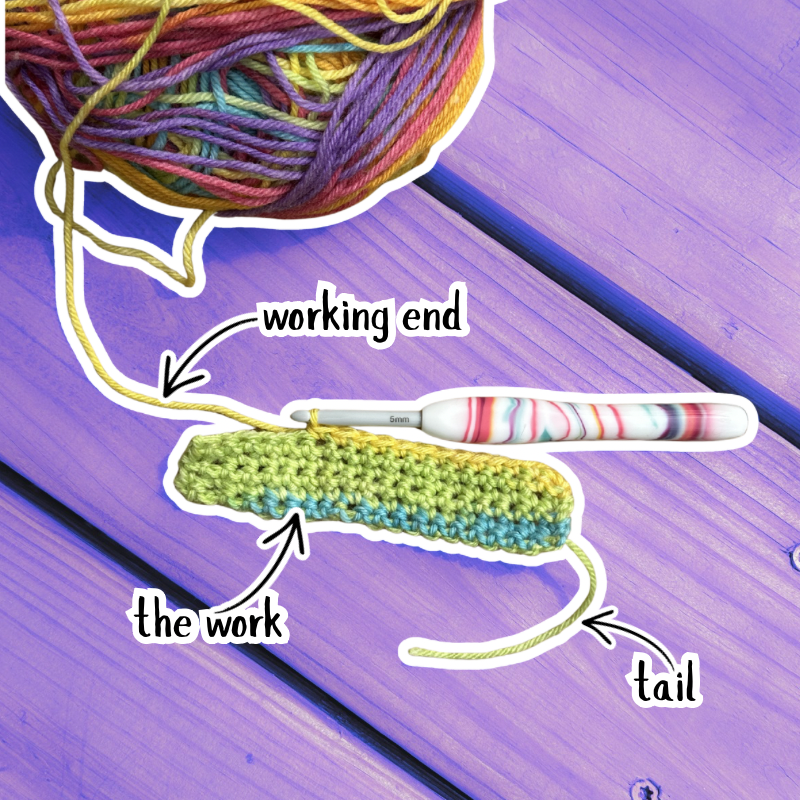
Illustration of the crochet yarn anatomy.
Anatomy of a Crochet Stitch
Did you know there are 27 bones in your hand? There are almost as many parts that make up a crochet stitch. That is an exaggeration, but there are several parts:
Loop: This technically is not part of a crochet stitch, but is a building block that creates a stitch. The loop is the part of the yarn wrapped around the crochet hook. You can have one loop or several loops on your hook depending on the stitch.
Top of the stitch (V): The top of a crochet stitch makes a V-shape. Crochet loops are pulled under the V unless the pattern specifies differently.
Front loop (FL): The front loop refers to the side of the V closest to your body.
Back loop (BL): The back loop refers to the side of the V furthest from your body.
Back bump: A back bump is found on the bottom side of a crochet chain, opposite of the V.
Post: When looking at the front of back of your work, the post is the vertical profile of the stitch.
Legs: The legs are the individual vertical strands below the V.
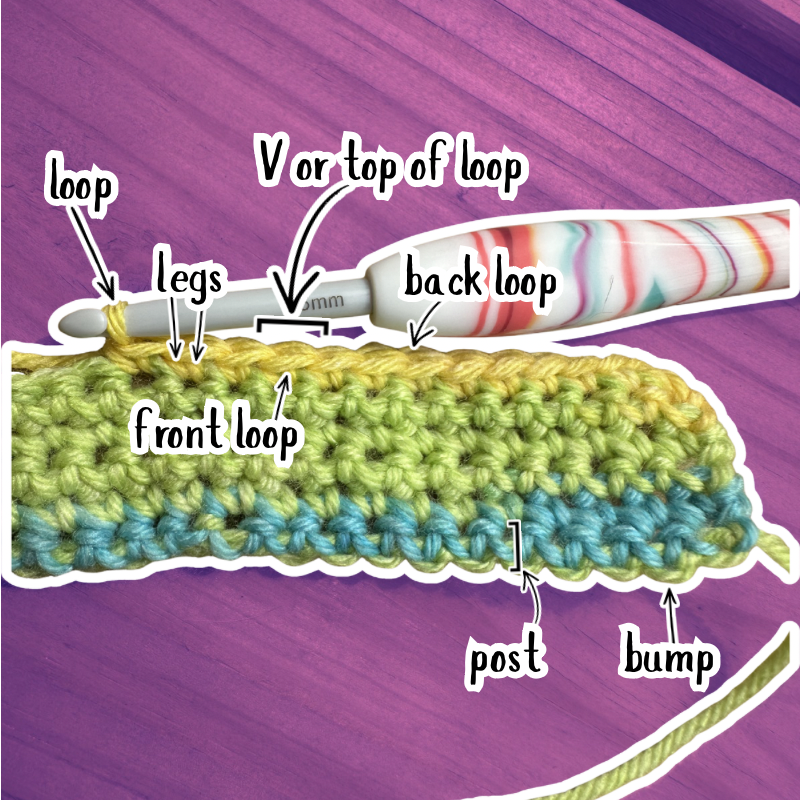
Illustration of crochet stitch anatomy.
Anatomy of a Crochet Hook
Understanding the parts of a crochet hook are not as critical as understanding the parts of a stitch. However, understanding these terms will give you the language to understand why you prefer some hook designs over others.
Hook: The hook of a crochet hook refers to the entire head including the tip, the chin, and the throat.
Tip: The tip is the leading edge of the hook that is inserted in the stitches. Some tips are blunt while others are pointed.
Chin: The chin is the tapered bottom-end of the tip. This works with the throat to catch loops.
Throat: The throat is the inside part of the tip, the angled bit between the chin and shank. It’s purpose is to catch yarn as you pull it into a loop.
Shank: The shank is the section of handle behind the tip. This diameter of the shank determines the size of the crochet hook and the size of the stitches. A larger shank means creates larger stitches. Yarn labels will recommend a size of the shank or crochet hook.
Thumbrest: The thumbrest is exactly what it sounds like. It’s the location where you thumb rests while crocheting. This part is more. Not all hooks have a thumbrest.
Handle: You hold the handle as you crochet. This is the end opposite of the tip. Handles can be very simple, just extensions of the shank. They can be ergonomic, adding comfort to your looping. They can also be fancy, beautifully designed by artists to meet your aesthetic.
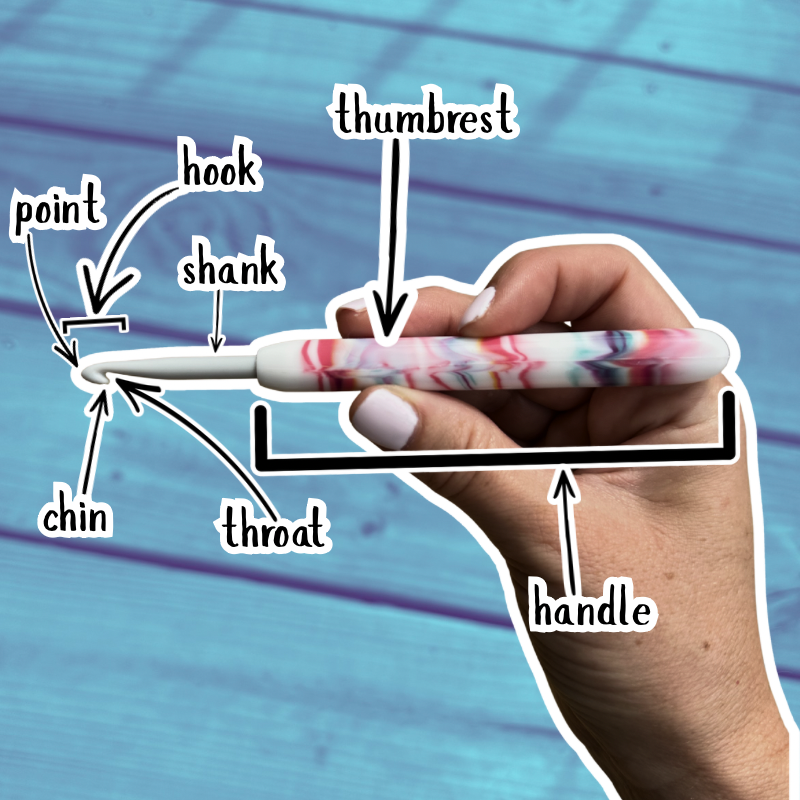
Illustration of crochet hook anatomy.